Challenge-Driven R&D Envisioning the Future
Interview with Nobuhiko Kubota, IHI Corporate Research & Development Division
In an era of rapid change, the ability to define issues is more important than the ability to define issues is more important than simply implementing solutions. What kind of future does IHI envision as it develops new technologies to service society? In this article, Nobuhiko Kubota, the General Manager of the Corporate Research and Development Division, talks about how the company is approaching technological development and performing new challenges, looking ahead to 2050.
IHI was established as a ship builder in 1853, 172 years ago. Subsequently, the company has provided many kinds of large-scale structures, including bridges, aero engines, and rockets, while also focused on the energy field, which includes power generators. Regardless of the sector, our ultimate purpose has always been to contribute to society. Our primary mission is to make the lives of current and future generations more comfortable and convenient by leveraging our technology.

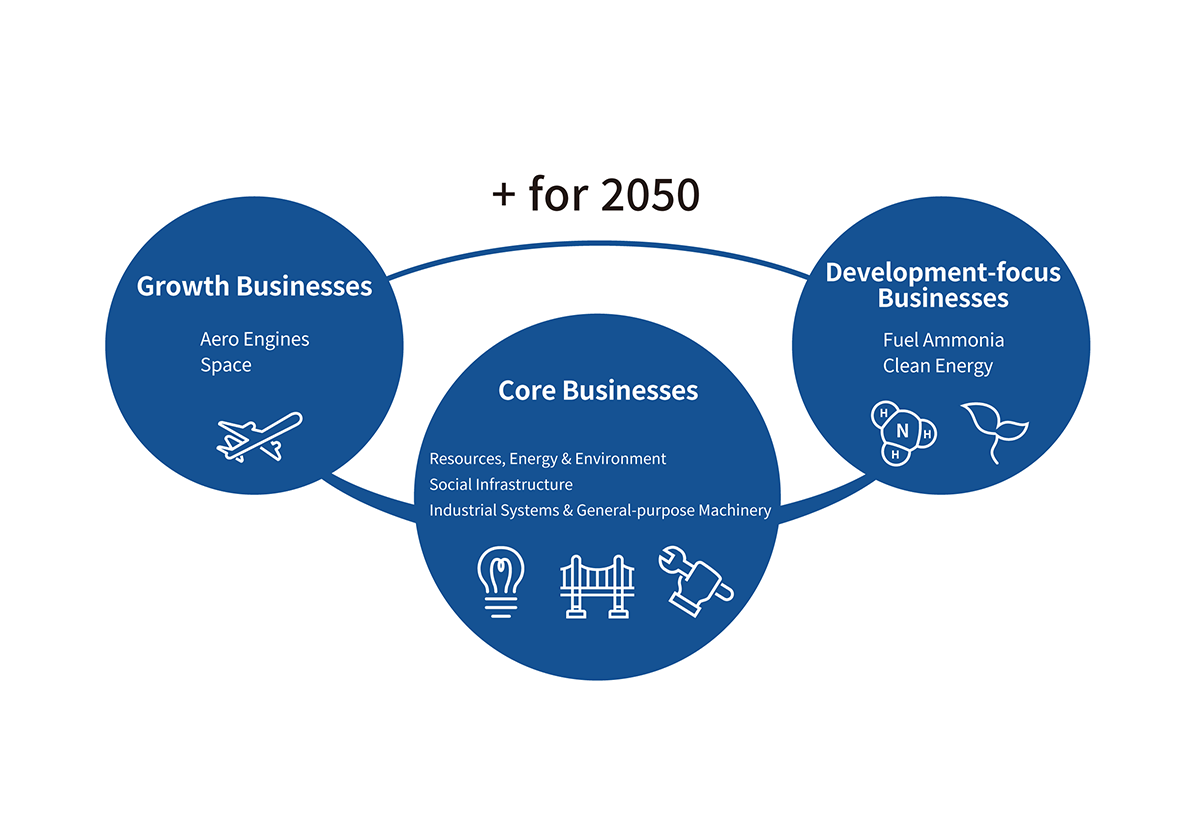
The IHI Group currently classifies its business fields into three types: Growth, Development-focus, and Core. Our Core Businesses span diverse sectors, including Resources, Energy & Environment, Social Infrastructure, and Industrial Systems & General-Purpose Machinery . As the word “Core” suggests, they are the traditional pillars of the company. Meanwhile, our Growth Businesses are mainly in the aero engines and rockets fields. For example, we are working to make jet engines lighter and decarbonize aviation fuels as part of our long-term road map.
Our Development-focus Business includes clean energies such as fuel ammonia. We need to develop more affordable and safer technologies to manufacture, transport, store, and use fuel ammonia, which is one of the priority themes for the Corporate Research and Development Division. If we can leverage ammonia as a fuel to generate power, it will help significantly reduce CO2 emissions and the technology we gain on the way will also allow us to become a significant leader in the industry.
We are also working on various research themes to address emerging needs for 2050 and beyond. This includes swarm control technology (technology for efficiently operating and controlling multiple robots) for automated and unmanned factories and logistics, nuclear fusion energy to power the increased use of generative AI, and quantum technology. These might sound to be topics for the far future, but we need to start working on them now. Carbon neutrality is currently the big focus, but beyond that lies circular economy, with biodiversity and Nature Positive status waiting further beyond. We need to be continually conscious about what we can do for the future.
Working on something that others have said is necessary is easy, but what matters is the ability to define potential issues. In general, I feel Japanese companies are good at solving issues, but struggle to define them. To accurately define issues, it is essential to know what pioneering leaders in the relevant fields are thinking about. To that end, we need to join the global leader ecosystem. By joining the leader ecosystem, we increase our visibility to the world, and we will be able to identify issues more precisely by discussing how the technology advances with other leaders. We may also be able to participate in standardization and law-making processes. IHI is currently working to gain a lead in the fuel ammonia field. For the first time, our company is working on the entire process from upstream to downstream, from developing fundamental technologies to doing things that a trading company would do.
Open innovation is also an important matter. In a rapidly – changing world, it’s impossible for one company to handle everything on its own. We need to consider partnering with other companies and institutions to develop technologies as quickly as possible. The key here would be to generate synergy with each other’s strengths, rather than complementing our weaknesses; 0.5 plus 0.5 only makes 1, but 1 plus 1 makes 2. For the past few years, forming alliances among pioneering leaders has been top of mind for us. The most important thing for achieving open innovation is sharing a road map. By sharing the final goal and milestones, optimal paths are naturally identified through discussions.
These days, I keep saying to my research team, “It’ll be alright even if you fail. Just give things a try.” For the past few years, we have been improving our organizational system to promote starting new trial projects. We now provide research funds for each department to spend on projects at their own discretion and have an award program to recognize employees for trying new things. I hope they think of something new. Even something that sounds far-fetched would be fine. If it doesn’t work, they can just give up. I just want them to give things a try. I’m already seeing signs of new growth. Even if they fail, they can just continue moving forward. I want each member to have this kind of mindset.
By 2050, people might be traveling to space more frequently. If people lived on the moon, which of our technologies would be useful? For example, one might immediately think of recycling CO2 from exhaled human breath, synthesizing hydrogen and oxygen to make water, or leveraging our shield technology cultivated in nuclear business to block radiation and cosmic rays. We’ll always need imagination to try applying the technology we are working with to a whole new purpose. We are not yet sure which technology will lead the era. The days are long gone when whatever we made would sell. Going forward, we need to start back-casting. Design is also important to resonate with customers, making them think, “This is what we wanted.” We need to start thinking about it at the initial design phase, rather than embellishing afterwards.
IHI has been providing many different products and services useful for society, mostly large-scale structures. Whether it’s a power generation facility or an aero engine, newcomers can’t easily build one from scratch. We must maintain our unwavering commitment to making reliable products to maintain customers’ confidence on the IHI brand and contributing to society. As a heavy industrial company with long-established experience and history, we need to continue preparing ourselves to contribute to society.
Collaboration Between the Two Centers for
Swiftly Bringing New Technologies to Society
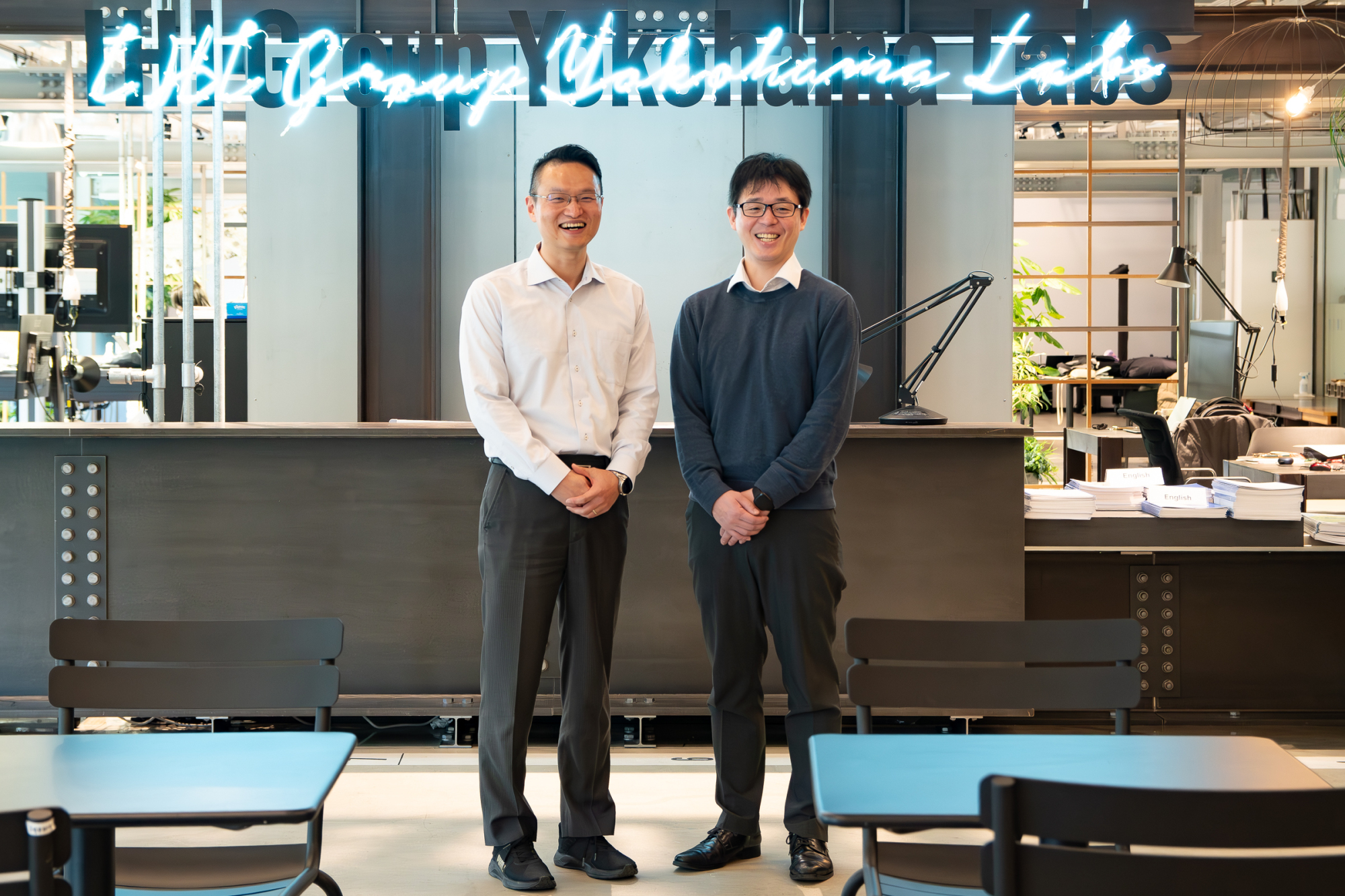
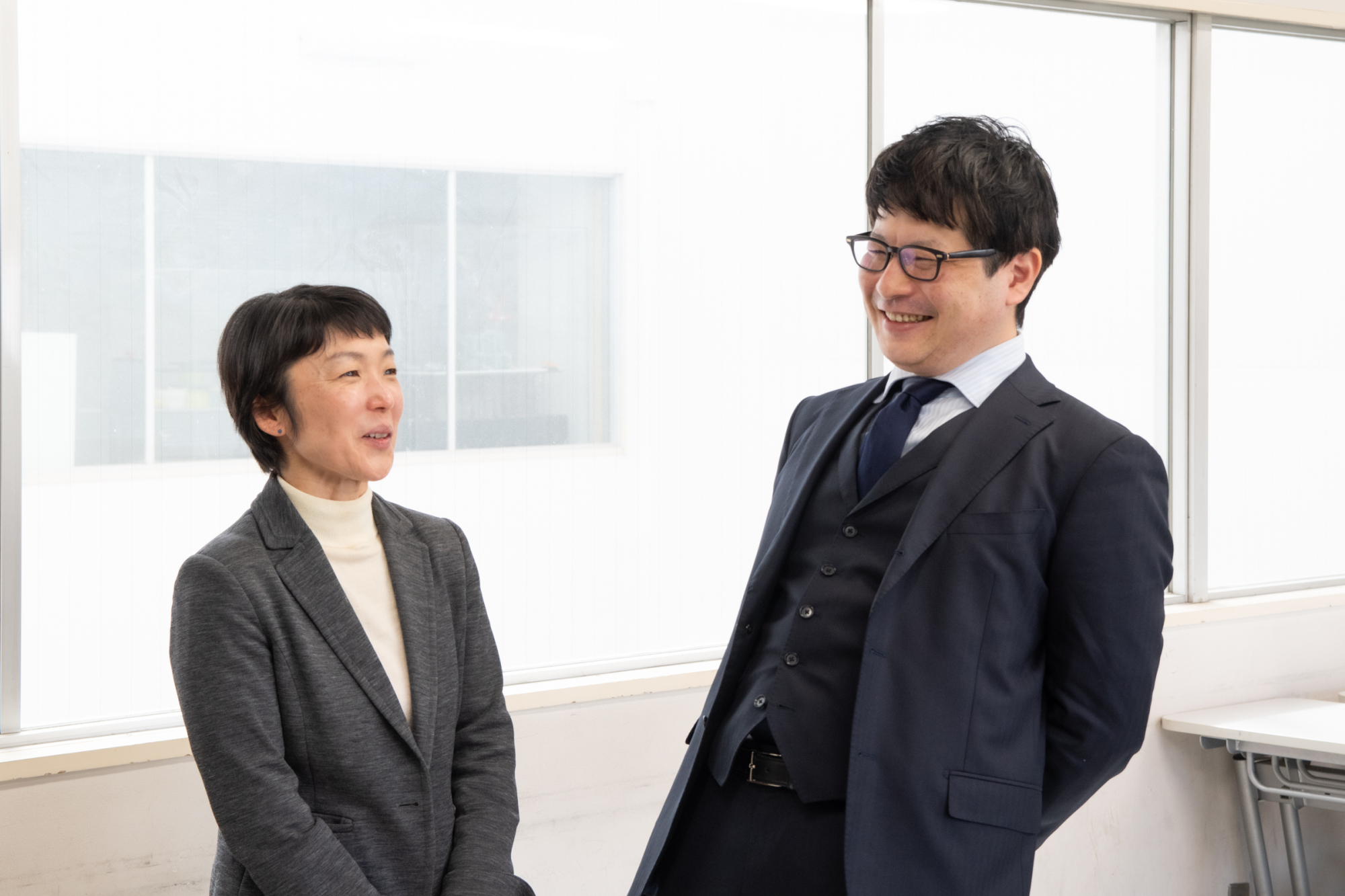
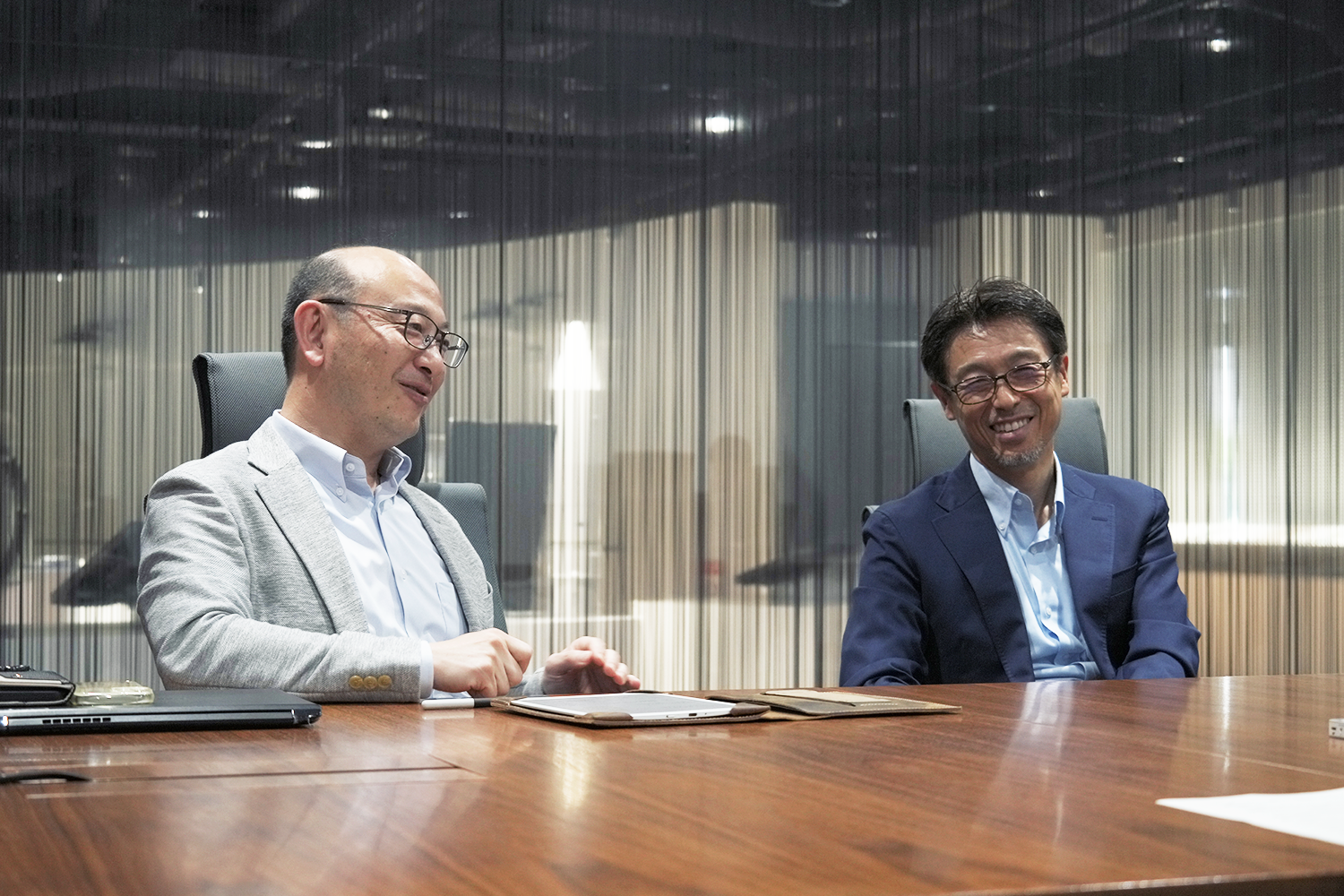
Interview with Yoshiaki Matsuzawa, Head of Technology Platform Center, and Naoki Oiwa, Head of Integrated Development Center
The Corporate Research & Development Division was restructured in 2024, with main responsibilities shared between two centers. This article features the leaders of the centers: Yoshiaki Matsuzawa, the head of the Technology Platform Center, and Naoki Oiwa, the head of the Integrated Development Center. They will discuss how their cooperation enables further advanced technological development and transformation, as well as their outlook for the future.。
── First, please briefly describe how the Corporate Research & Development Division is structured.
Yoshiaki Matsuzawa (hereafter “Matsuzawa”):The division was reformed in 2024 and currently has two centers: the Technology Platform Center, which is the one I oversee, and the other is the Integrated Development Center, which Oiwa oversees. The Technology Platform Center has seven platform technology departments. They cover physics and chemistry, energy conversion, advanced manufacturing processes, materials and structures, control and sensing, turbomachinery and machine elements, and mathematical engineering. The Integrated Development Center is on a mission to integrate these fundamental technologies to enhance their degree of practicality with the aim of bringing them closer to finished products and services. The Corporate Research & Development Division currently has about 640 employees, and many of them are engineers.
Naoki Oiwa (hereafter “Oiwa”):The Integrated Development Center is organized into two departments and one group. Of the two departments, one handles development planning and the other handles engineering. Our mission is to serve as a bridge for delivering developed technologies to the business division. Most fundamental technologies are not usable on their own, so we think about how we can integrate them into products and services and explore how they should be manufactured, including what materials to use. By doing this, we integrate multiple fundamental technologies to create a usable product. Another major mission for our center is planning and implementing engineering for overall optimization by building models that provide a comprehensive view of products and systems.
The remaining one group also plays the important role of building and maintaining the IHI Group’s buildings and factories.
Matuszawa:Put simply, imagine we want to build a flying car powered by rotor blades. To lift the heavy vehicle body, the teams of those skilled in rotation technology and aerodynamics discuss the core technologies. But this alone would not be enough to make the car fly. As we get closer to the final product, we need to consider other aspects of the product, such as what materials to use for the body, how to even assemble it, and how to control the car in the air. So these jobs are shared between the two centers.
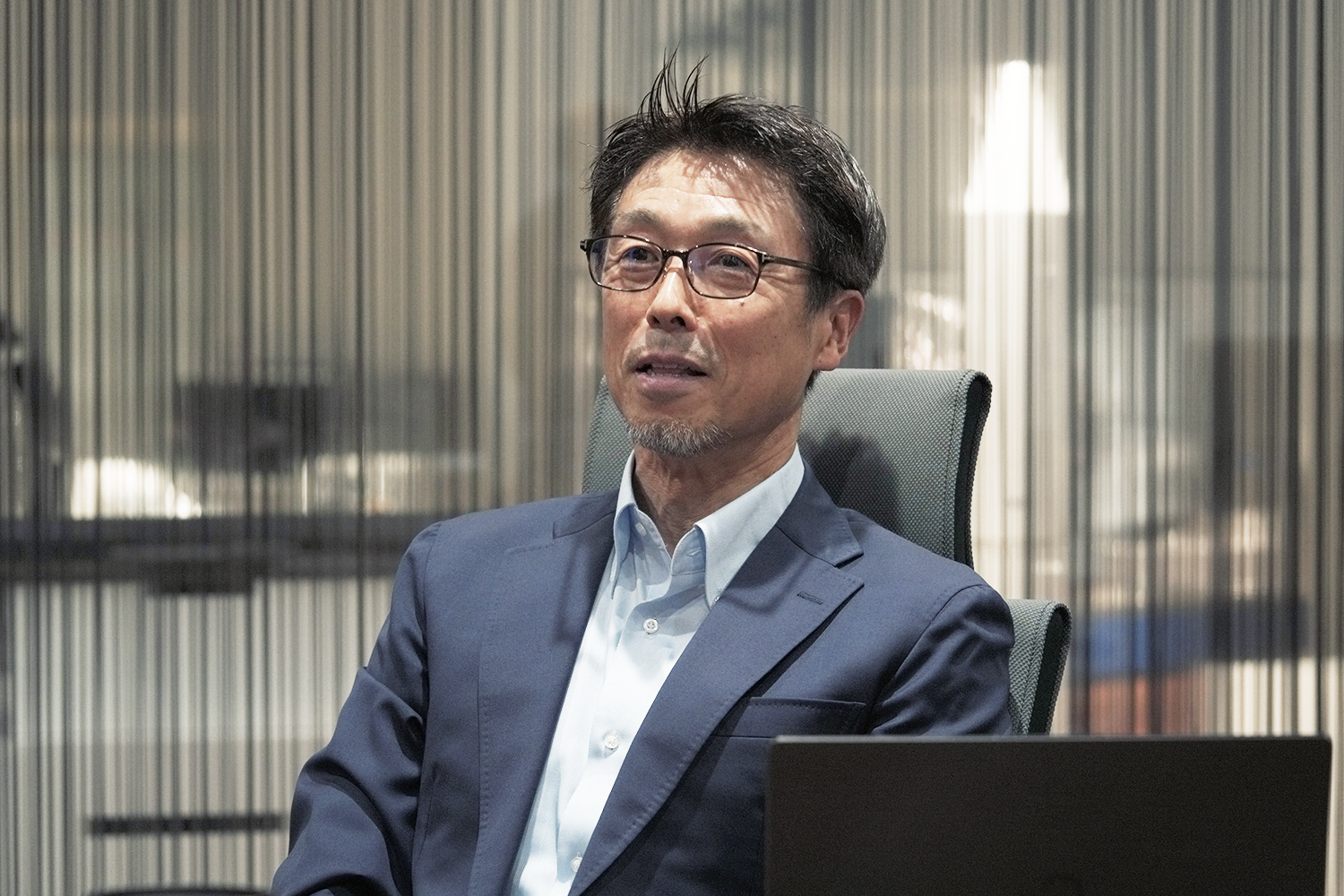
Oiwa:We often ask them, “please improve the performance of this technology.” However, it’s not simply a matter of upgrading performance itself; but it’s an indirect request, despite high hurdles, to enhance the product’s appeal through technological improvement. Our division does not produce and market final products. It’s the business division that does that. But in the development phase, we closely work with the Technology Platform Center to get individual fundamental technologies one step closer to finished products.
The reason why the division was reformed is because for the past few years, we’d been focusing too much on improving individual technologies, and hadn’t been putting as much effort into combining them to create something close to a real product. For our existing products or something close to them, all we had to do was to provide our division’s advanced fundamental technologies for the business division to use as they are. But to continue contributing to society using technology in a future that’s becoming more uncertain, we thought new products that the business division doesn’t have yet would be required. Then, this put us in an additional dilemma. Both the business division and we didn’t have anyone who looked at a product or service from a holistic perspective, asking, “How can we use this technology?” or saying, “This isn’t enough by itself.” We have terms like “Devil’s River” and “Death Valley” for this kind of situation. To future-proof ourselves, we decided to do something more than just R&D of fundamental technologies. We started trying to flesh things out better in our division before handing them over to the business division.

── Tell us how new technologies are developed.
Matsuzawa:The Technology Platform Center usually proposes new fundamental technologies. There are basically two paths we can take: one is something relatively close to a final product. Let’s think about the major challenge of reducing CO2 in the atmosphere. We present such challenges from the top down, and each department proposes many different technologies. The other path is looking into totally new fundamental technologies that could go in any direction. Because 20% of the R&D budget is for discretionary use, some members are working on things they are genuinely excited about within that budget. This helps motivate our researchers and may be the most exciting part of developing fundamental technologies. But only about three out of 1,000 ideas lead to great inventions.
Since I became the head of the center last year, we have been trying some creative approaches to promote innovation. For example, we have a program where representatives with completely different expertise from the seven departments participate in discussions to generate themes. I believe the key lies in how we can leverage diversity and integrate technologies from different fields.
Oiwa:The Integrated Development Center usually needs to think backward from set goals, so we don’t do much discretionary research. But this does not mean that we are not allowed to be creative. I make sure to tell my team, especially younger members, that thinking backward from the goal also allows us to discover something groundbreaking: something that the Technology Platform Center did not even think of.
Matsuzawa:Breaking down challenges into smaller pieces also helps develop new technologies. Society is facing lots of issues like an aging population, declining birthrate and global warming. But we first need to think about which issue we can do to solve. To that end, we have defined six pillars. The first one is carbon neutrality. For example, we are developing technologies to utilize fuel ammonia and to make fuels and chemical materials from CO2 and hydrogen. We are also working on a technology for aircraft electrification. This would make an airplane version of hybrid cars. For daily life, technologies for maintaining infrastructure, preventing and mitigating disasters and creating new materials may help. Other major themes include operational technologies, such as swarm control of robots, and digital transformation. We break down these themes into smaller pieces to develop new technologies.
Of course, some ideas may deviate from these themes. But we surely want to expand from such ideas, too. We even welcome ideas that will increase the six pillars to seven.
Oiwa:For our ongoing research projects, we have set the first milestone for around 2030 to 2035, while looking ahead to 2050.
── Tell us about the importance of joining the leader ecosystem.
Matsuzawa:As Kubota also told, ammonia is a good example to explain it. I think we are an industry leader in the fuel ammonia area. One reason why joining the leader ecosystem matters is because we would be able to establish proper rules while working closely with other involved parties. When technology spreads, you see more low-quality products out there, but we think standardization is a form of our social contribution in that products certified under standards can ensure reliable quality. I hope that we will see more technologies like the one for fuel ammonia.
If we just stay within our own bubble, we become increasingly stuck in conventional thinking patterns. So the key is to expose us to fresh external views and perspectives as much as possible. We need to think about how we can expose ourselves to these things, including the leader ecosystem. It’s about incorporating diversity from outside the company.
Oiwa:As Matsuzawa said, it’s very meaningful to have discussions with a diverse range of people. Engineers may be able to pick up new ideas by talking with people from around the world at international academic meetings. For example, people in Europe are leading climate talks and have different perspectives. Of course, we want to join the leader ecosystem partly because we want to be an industry leader, but I would like engineers to use this as an opportunity to gain new ideas, too.
The same is true for what we can do internally. IHI operates in a wide range of sectors and has diverse talents. For example, people making turbochargers and those building plants use different terminology and approach design and quality assurance differently, too. By speaking to different teams, we can gain new insights and realize that each team has their unique strengths. On that note, I ask engineers to respect one another. If people work on different things, they naturally have different objectives and approaches, so this is not about who’s right or wrong. By putting together our experiences, we can create new business opportunities and products. It will also help generate new useful ideas.
── At your centers, what do you think your teams should look like going forward, and what do you expect from them?
Oiwa:For our center, what’s important is to look at the whole picture. We need to consider everything, including materials and parts used in finished products. But if we tried to do everything on our own without any help, it would take a lot of time. There are basically two ways we can look at the whole picture with less time
: one is to make the most of AI, which is evolving rapidly, and the other is to ask experts for advice, which is traditional and common practice. In that sense, the Integrated Development Center has many designers that are good at seeing the whole picture. I think it’s desirable for more designers to show their character that they naturally connect with others. We already have some designers like that, and I hope they will lead the team more actively.
Matsuzawa:Because I come from a chemistry background, I enjoy experimenting. As I find a similarity between experiments and organizational changes, making a new modification to organization is interesting for me. I like thinking about how to change things for the better. In particular, I feel the efficiency of R&D is correlated with the organizational system. I’m interested in seeing whether things will go as I expect when we change the system.
Oiwa:In that sense, establishing the Integrated Development Center in itself was an organizational experiment. After all, the Corporate Research & Development Division has focused on technology for many years, so thinking about end-products is a challenge for us. I see people reacting in different ways, including my seniors. Some say, “This is just the way how I have wanted to do,” but others say that they just like developing technologies. Some get confused when told to start thinking backward from set goals. But I believe that this change is essential for our division to continue developing technologies that will materialize new products in the future. We may not see results right away, but I hope that in five or ten years, we’ll be able to say, “It all began at that time.”
Matsuzawa:I look forward to having a diverse talent pool at IHI, especially people who are curious about the outside world. People who actively engage with it and care about their personal growth would be great.
Oiwa:I agree. I would like people who actively share their ideas, and things they find interesting and want to try. I want a positive and proactive spirit in all the engineers of the Corporate Research & Development Division.
Interviewed and edited in Japanese by Mai Tsunoo, a writer